I have written a Manifesto for WalrusInk. It's several paragraphs long, but in essence, it boils down to:
 WalrusInk: ePublishing friend of authors and foe of tyranny!
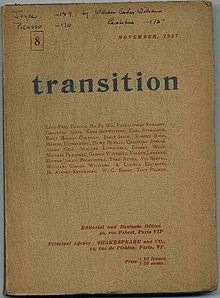
We don't talk seriously about manifestos and tyranny these days, but I'm attracted to the revolutionary fervor of these words. And then I was talking on the phone with my friend, Kenny, and he started talking about one of his former students who wrote a masters thesis about Transition Magazine and Marcel Duchamp. I had never heard of Transition Magazine, so while we were talking, I looked it up in Wikipedia, which is where I live a good deal of my online time.
"Transition was an experimental literary journal that featured surrealist, expressionist, and Dada art and artists. It was founded in 1927 by poet Eugene Jolas and his wife Maria McDonald and published in Paris."
I had discovered an example of 20's radical idealism that somehow wasn't included in my studies of utopian architecture and planning from the period. This was pure art for art's sake as a means to save the world. None of the semi-concrete "machine for living" or "contemporary city" idealism of Le Corbusier and his followers. But either way, weather you build it of words or wood, there's something quaint and naive about 20s idealism, especially in light of history, which pretty much goose-stepped all of that creative energy, turning it into hatred, war, and oblivion; a bitter irony.

What makes Transition apropos to WalrusInk, is their manifesto, which is a model of revolutionary fervor and chest-beating; an attempt to cast off what they saw as literary handcuffs in favor of a new world order created in words. Back to Wikipedia:
"The journal gained notoriety in 1929 when Jolas issued a manifesto about writing. He personally asked writers to sign "The Revolution of the Word Proclamation" which appeared in issue 16/17 of transition. It began:
"Tired of the spectacle of short stories, novels, poems and plays still under the hegemony of the banal word, monotonous syntax, static psychology, descriptive naturalism, and desirous of crystallizing a viewpoint... Narrative is not mere anecdote, but the projection of a metamorphosis of reality" and that "The literary creator has the right to disintegrate the primal matter of words imposed on him by textbooks and dictionaries."
WalrusInk is not nearly so militant about disowning our literary heritage. In fact, we're very aware of celebrating the past while accepting change and looking forward to all that technology promises. But we do find ourselves ready to cast off much of what has come before us in the publishing world. In a way, we see an ePublishing revolution as the savior of publishing, which has become shackled to old business models based on 19th century manufacturing, distribution, and accounting. We even believe that by trying to squeeze every penny of profit out of this untenable model, publishing has given up any sort of gravitas or moral center that used to account for much of what was exciting and worthy in publishing.
Like Transition, we welcome new ways of approaching old problems and see this as a timely and necessary part of the general dissemination of knowledge. What gives this the flavor of a revolution is the resistance of the status quo to change, which explains why WalrusInk has chosen to go outside of the status quo to adopt the new models made possible by electronic publishing, pervasive computing, and a lot of forward-thinking writers.
Viva la WalrusInk manifesto! Sic Semper Tyrannus, and viva la revolution!


