Friday, December 3, 2010

The End of Words, or South-Bound Dictionaries

I wrote this last year, Thanksgiving 2009, though why I never posted it is unclear: sloth, forgetfulness, doubt, the usual excuses of an unfocused mind. But I find my work in this case to be of a timeless nature, so I'm publishing it now.

Twas the day after Thanksgiving, and all through the house, not a creature was stirring, except in the living room. The stockings were hung by the fireplace with care, in hopes that they'd dry out, because it was raining.
We are all reading: Katharine is halfway through Wolf Hall, a 700-page fictionalized account of Henry VIII that recently won the Man Booker Prize. Marian has a script from her friend, Edward Albee, and she's busily underlining with a yellow marker. Wells has left the room to tend to the roasting sweet potatoes and spend some quality time with his chemistry textbook.

I am browsing, rather than actually reading, through the Apple iTunes store for anything having to do with Portugal in general or Lisbon specifically. There are travel apps for guide books, maps, and language study; audiobooks, a walking tour of Lisbon and a recently published book about the great earthquake, tidal wave, and fire of 1755 that is referred to by Voltaire in Candide; and there are lectures from iTunes U. that touch on matters Portuguese from numerous angles, including matters economic and political.

But it is Katharine who brings up the subject of zymurgy—actually, the discussion is focussed on the word rather than the subject. There it is, right in the middle of a paragraph, in the middle of the page, in the middle of a chapter, in the middle of Wolf Hall. I've looked it up, now.

zy·mur·gy (zī'mûr'jē)
n. The branch of chemistry that deals with fermentation processes, as in brewing.

So says the American Heritage Dictionary, and Katharine remarks that it is just like the word "enzyme." She can make these rapid word associations because she's studied both Greek and Latin, though only Greek matters in this case. But then follows this gem of randomness; a fact so trivial and yet so profound, that I barely know what to say, except that I shall treasure this bit of knowledge and use it in conversation as often as possible.

The following I quote in it's entirety from dictionary.com by way of the Online Etymology Dictionary.

Word Origin & History

zymurgy
branch of chemistry which deals with wine-making and brewing, 1868, from Gk. zymo-, comb. form of zyme "a leaven" (from PIE base *yus-; see juice) + -ourgia "a working," from ergon "work" (see urge (v.)). The last word in many standard English dictionaries; but in the OED [2nd ed.] the last word is zyxt, an obsolete Kentish form of the second person singular of see (v.).


Wednesday, December 1, 2010

The Transition Manifesto: Revolution or exaggerated idealism?

I have written a Manifesto for WalrusInk. It's several paragraphs long, but in essence, it boils down to:

WalrusInk: ePublishing friend of authors and foe of tyranny!

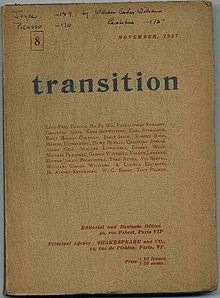
We don't talk seriously about manifestos and tyranny these days, but I'm attracted to the revolutionary fervor of these words. And then I was talking on the phone with my friend, Kenny, and he started talking about one of his former students who wrote a masters thesis about Transition Magazine and Marcel Duchamp. I had never heard of Transition Magazine, so while we were talking, I looked it up in Wikipedia, which is where I live a good deal of my online time.

"Transition was an experimental literary journal that featured surrealist, expressionist, and Dada art and artists. It was founded in 1927 by poet Eugene Jolas and his wife Maria McDonald and published in Paris."

I had discovered an example of 20's radical idealism that somehow wasn't included in my studies of utopian architecture and planning from the period. This was pure art for art's sake as a means to save the world. None of the semi-concrete "machine for living" or "contemporary city" idealism of Le Corbusier and his followers. But either way, weather you build it of words or wood, there's something quaint and naive about 20s idealism, especially in light of history, which pretty much goose-stepped all of that creative energy, turning it into hatred, war, and oblivion; a bitter irony.

What makes Transition apropos to WalrusInk, is their manifesto, which is a model of revolutionary fervor and chest-beating; an attempt to cast off what they saw as literary handcuffs in favor of a new world order created in words. Back to Wikipedia:

"The journal gained notoriety in 1929 when Jolas issued a manifesto about writing. He personally asked writers to sign "The Revolution of the Word Proclamation" which appeared in issue 16/17 of transition. It began:

"Tired of the spectacle of short stories, novels, poems and plays still under the hegemony of the banal word, monotonous syntax, static psychology, descriptive naturalism, and desirous of crystallizing a viewpoint... Narrative is not mere anecdote, but the projection of a metamorphosis of reality" and that "The literary creator has the right to disintegrate the primal matter of words imposed on him by textbooks and dictionaries."

WalrusInk is not nearly so militant about disowning our literary heritage. In fact, we're very aware of celebrating the past while accepting change and looking forward to all that technology promises. But we do find ourselves ready to cast off much of what has come before us in the publishing world. In a way, we see an ePublishing revolution as the savior of publishing, which has become shackled to old business models based on 19th century manufacturing, distribution, and accounting. We even believe that by trying to squeeze every penny of profit out of this untenable model, publishing has given up any sort of gravitas or moral center that used to account for much of what was exciting and worthy in publishing.

Like Transition, we welcome new ways of approaching old problems and see this as a timely and necessary part of the general dissemination of knowledge. What gives this the flavor of a revolution is the resistance of the status quo to change, which explains why WalrusInk has chosen to go outside of the status quo to adopt the new models made possible by electronic publishing, pervasive computing, and a lot of forward-thinking writers.

Viva la WalrusInk manifesto! Sic Semper Tyrannus, and viva la revolution!


Thursday, April 8, 2010

iPhone OS 4.0 Press Conference Summary


Steve Jobs announced iPhone OS 4.0 today. The big headline is that multitasking comes to the iPhone. The beta is available to registered developers today and the ship date is for Summer. iPhone OS 4.0 will not run on iPads, which will continue to use either iPhone OS 3.2 or a 3.x interim update. iPhone OS 4.1 (or 4.x), which is slated for Fall delivery, will bring multitasking to the iPad.
Today: Developer beta of iPhone OS 4.0
Summer: iPhone OS 4.0 ships (3GS and iPod touch 3rd gen. iPhone 3G and iPod touch 2nd gen will not do multitasking.)
Fall: iPhone OS 4.x unifies new features for iPad and iPhone

No new hardware was announced today, but here are the 7 key new features as enumerated by the master of the reality distortion field, himself.

1. Multitasking
2. Folders
3. Enhanced email
4. iBooks
5. Enterprise
6. Game Center
7. iAd Mobile Advertising

Here's a bit more detail on each of what Apple is calling the 7 "tentpole" features of iPhone OS 4.0. It's worth noting the three of the tentpoles are aimed at markets controlled by BlackBerry (mobile email), Microsoft (corporate datacenter), and Google (interactive advertising). Of the other four, Multitasking is the game-changer, Folders is a nice feature, iBooks is a no-brainer, and Game Center puts a bunch of 3rd-party APIs out of business.

1. Multitasking; it's all about the UI implementation. No limits on concurrency and no "battery drain." It's a very thoughtful and rich implementation that keeps the iPhone user experience well ahead of pursuers.
seven multitaking services as APIs to developers
1. Background audio
2. VoIP
3. Background location
4. Push notifications
5. Local notifications
6. Task completion
7. Fast app switching

2. Folders; not a file system, but a way to organize and categorize apps. Probably the #1 requested feature by people who don't understand why Multitasking is actually a much bigger deal.
180 -> 2,160 apps

3. Enhanced email; one more bastion of BlackBerry superiority falls to Apple's rapid enhancements
Unified inbox
Multiple Exchange accounts
Fast inbox switching
Threaded messages
open attachments with apps

4. iBooks; an obvious addition, but it does allow for buy once and read anywhere and it is the finest eBook consuming implementation currently available.

5. Enterprise; full-frontal attack on IT and the enterprise datacenter (good thing we've got "Enterprise iPhone and iPad Administration" just getting ready for re-launch.)
Better data protection
Mobile Device Management
Wireless app distribution
Multiple Exchange accounts
Exchange Server 2010
SSL VPN support

6. Game Center; incremental improvement currently being provided by 3rd-party APIs
Social gaming network


7. iAd Mobile Advertising; this one's the big sleeper with potentially huge revenues for Apple. Apps are to Apple what search results are to Google.
Emotion + interactivity
Ads keep you in your app
Built into iPhone OS
Apple sells & hosts the ads
60% revenues -> developer


Tuesday, February 16, 2010

Personal History: On Turning 50

I found this in my old folders from April, 2002. It has no current significance except for the fact that I happened to find it this week. At the time, I was an editor for Manning publications, my first editing job after fifteen years as an author and journalist. Two jobs and some years later, I'm an editor again, which is a satisfying thing to be, but I think about writing, especially now that all offspring are either in or finished with college. What will I think upon turning 60? Stay tuned…

April 30, 1952

The burden of turning 50, a remarkable if not unprecedented event. It is as remarkable and ordinary as the day of my birth, April 30th, 1952. The young mother, Amelia, aged 27, experiencing her second birth in less than two years. “Twilight sleep” was the common practise for hospital deliveries then, thus saving the mother from at least a portion of her own experience. The young father, Reubin, almost 29, having attended numerous, though not many, births as a medical intern and resident, had a doctor’s authority to attend his own son’s birth at the old Johns Hopkins Hospital in Baltimore.

The parents’ experience of my birth date me as assuredly as the political events of the day. Truman, a baby of the 19th century, was still president. Can my own children believe that I have lived through 11 presidents and the entire cold war? This should qualify me as something of a veteran, but it in no way defines me; no more than my age.

I do not remember my other remarkable birthdays. The turning of 10, 20, 30, and 40 bring back no special memories of grand celebrations or events of note. I remember a birthday party when I turned seven. We had recently moved to the house where my parents still live. I remember a sunny, mid-spring day and an underfurnished house. My friends, Jan Frisky, Jay Gouline, Hugh Hayes, Stevie Wexler, and Bruce Daniel (who alone remains a friend), joined the celebration of Russian tea, carrot sticks, and strawberry shortcake. Did we have hamburgers and hot dogs? I don’t remember.

It’s not possible that this was my only childhood birthday party, but none of the others left any sort of impression on my memory. There are movies of my older sister Julie wearing a tutu for her sixth birthday at the old house on St. Dunstan’s road. There was pin the tail on the donkey and musical chairs, my father had a brand new, pre-stereo, hi-fi, and he controlled the lowering and lifting of the tone arm on the turntable. It might have been a recording of Benjamin Britten’s Young Person’s Guide to the Orchestra on a 78 RPM, long-playing record.

If my two younger brothers had birthday parties, I have only the vaguest memories of them. Laurie, one year younger, favored chocolate ice cream and managed get it on his person in the most unlikely places, behind the ear being one that lives on in the family lore. I remember baby Tommy, only three years younger, but the baby much past his infancy, experiencing cake and ice cream for his first birthday. He had a low baby table with a seat practically in the middle of it. There was plenty of room to spread birthday dessert all around in typical one-year-old fashion.

Age 13 was surely important for most of my friends, who celebrated with Bar and Bat Mitzvahs followed by luncheons and dinner dances. I remember many of the individual parties of that year, but not my own. I shall never understand the significance of “sweet 16.” I suppose it is a debutante thing, because only girls had a fuss made over their sixteenth birthdays. I assuredly made none made over my own.

When I turned 19 and was freshman at college in St. Louis, I remember my mother sternly reprimanding me over the phone for a lack of achievement and a complacent manner. I don’t know why she felt called upon to rebuke me on my birthday. I’m sure it is not something she would like to be reminded of. I was in architecture school, a place I had wanted to be for many years, but a place that brought me no pleasure or satisfaction. In my memory, it stands as my worst birthday. Could any others have been so disastisfyingly gloomy? I don’t think I wept, but there was no sense of pleasant satisfaction on that day.

18 was a more momentous anniversary. For the first time, one could both vote and drink at age 18, and there was the sense of insobrietous power. That was 1970, my senior year of high school, and the headlines for my birthday were punctuated by President Johnson’s bombing of Cambodia, which brought about the subsequent shooting of students by the National Guard at Kent State, a fateful turn in the ill-fated war in Vietnam and anti-war protests. My first presidential vote was cast for Hubert Humphrey, a personal acquaintance of my parents who had been friends with his sister, whom I remember as a large, brassy, smoker married to another Hopkins doctor.

I have no recollection of my second birthday in St. Louis, number 20, and nothing significant remains with me from my 21st birthday celebrated in Bennington, Vermont. However, among my few memorable birthdays, the 22nd, still in Bennington, is perhaps the best remembered. A few of us went to a Japanese restaurant outside of town. There were five of us: my brother Tom, then in his first year at Bennington; David Shorey, who became a dealer in antique flutes and is now a fugitive living in Amsterdam having been convicted of felony possession of Marijuana charges in Maine; Raymond Gargan, who has remained a friend and has also become a professional colleague, and Katharine Claman. David, as organizer of the event, brought two wild flowers of Bennington’s late spring that he had dug up and potted, a marsh marigold for me and blood root for Katharine, who nearly shared my birthday, hers being on the 28th. We have shared all our birthdays since and though we were just friends and not yet intimates for that first mutual celebration, every birthday since has reminded me of marsh marigold and blood root.

Why can I remember no other birthdays beyond the names of a few restaurants? They did not go uncelebrated. Another Japanese meal in Ithaca, New York with Katie Kazin, whose rare correspondences, including one for Katherine’s birthday this year, arrive by email from Jerusalem. Lunch at Chez Panisse in Berkeley, California, which was our regular Saturday indulgence at the time. I know that there have been many strawberry shortcakes and many friends to share them all. There were no children when I turned 30 in Palo Alto, California, and three sons by the time I turned 40 in Litchfield, CT.

I think I will remember the tiny wine room at Picholine, an elegant New York restaurant where my parents hosted this year’s personal silver anniversary. It is not so many months since Bush the younger became a war-time President, but the Twin Towerless city is filling its restaurants again. There is still a table of pictorial hero and disaster books at Barnes and Noble near Lincoln Center, but the table is less prominent and the books are fewer.

I have never felt the need nor had the desire to mark birthdays in a major way, but I do enjoy a dinner with family a friends. If birthday’s provide an excuse for such gatherings, then they are occasions worth celebrating. But no birthday seems more important or “bigger” than another. I have pointed out to my children that if we had eight fingers instead of ten, the eights would be an excuse for more marked celebration. And if we lived on Mars, there would be a longer time between annual events. The progress of time may be inexorable, but the counting of it is a man-made convenience. For me, personal memories are fixed in time as much by events as by any sense of age. 20 years of school, marriage, births, and the different places I’ve lived hold greater importance than the mere achievement of a half-century of enduring.

Sunday, October 18, 2009

Me and Apress; reflections on Two Years

I don't know the exact day I started work for Apress, but it's just about exactly two years ago, late-October, 2007. Apress is still a publisher of tech books and I am still a heavily-bearded fellow, but neither Apress nor I are really the same. Most obviously,we've weathered a major reorganization at Apress—the move from Berkeley to New York, new hierarchy, new personnel, new systems, new workflow. Yet we are finishing a challenging year strongly. I feel very good about this new enterprise that is Apress.

Less obvious, but much more inevitable, I've changed, too. I'm more knowledgeable having learned to make books the Apress way. I'm more responsible; the MacDev and iPhone "line leader," which includes the awe-inspiring title, Assistant Editorial Director. (I still prefer to think of myself as an editor.) I'm more "important," which I put in quotes to indicate that this refers to the books I publish. There are more of them and they sell more copies than the books I acquired during my first year as Apress editor.

Every organization has its own culture and methods. This is a given, a challenge made more difficult by our virtual collegiality, with no two editors in the same city and spread across three continents, and yet made less challenging because all of my editorial colleagues have been generously kind and unselfishly helpful—the spirit of mutual cooperation I've written about before and still value highly. All of this has helped to make me a more confident editor and I hope a better one, as well.

I fear that I'm sounding too much like a marketing campaign for myself, which is not the intent. While there's something unavoidably self-serving about writing a personal blog, my intent is not to celebrate, but to talk about events and give my impressions. In this case, the story is the simple fact that after two years, I'm still happy to be working at Apress. And I observe that Apress and I have changed together over this period, and there's no separating these two facts.

Much of my life today is defined by my work as an Apress editor, it's very much a part of my identity, something I'm proud of. At the same time, after almost a year of Mac and iPhone books on the market, I think Apress has, if not exactly a new identity, at least become more widely known and respected. Perhaps I've become more widely known and respected, as well. Let's hope we both deserve it. Perhaps year three will provide the answer.

Tuesday, June 30, 2009

Kiss my Occam's Razor


I bristle at the mere mention the K.I.S.S. principle. My structures professor at Cornell School of Architecture was the first person I knew who referred to this, but it somehow seemed to apply to the design of steel structures for building. Some year's later, I had an incompetent manager who referred to K.I.S.S. nearly every time he faced a difficult decision. I soon realized that the principle had more to do with stupidity than simplicity. Perhaps this is why it's such a popular refrain of thoughtless decision makers trying to avoid the inevitable hard decisions of everyday life.

Its overuse, over-application, and overly-simplistic nature make K.I.S.S. essentially useless. In fact, it becomes a self-fulfilling prophecy of stupidity. And you can't argue when someone puts their foot down in the quagmire of K.I.S.S., because it just makes you seem contrary for no good reason. It's as if K.I.S.S. were the secret code for "we're not going to talk about this, any more."

However, there is an undeniable germ of truth in this principle that I, too, find attractive. Simplicity really is a good thing and I often speak of the elegant simplicity of designs that I admire. But elegant simplicity is a rare thing and hard to achieve. It's the antithesis of stupidity, and is more correctly summarized by Occam's Razor, or the Law of Succinctness.

http://en.wikipedia.org/wiki/Occam's_Razor

Essentially, given two theories that say the same thing, one chooses the theory that introduces the fewest assumptions. In scientific inquiry, one continues to apply Occam's Razor in binary fashion (applicable to computer science) until one has eliminated as many assumptions as possible and produced the most succinct, or simplest, result. Instead of shutting off debate, Occam's Razor invites debate as a means for achieving understanding in complex situations. Which means that Occam's Razor also recognizes complexity as the pre-existing condition. Complexity, debate, and the process of finding the finely-honed solution based on the fewest number of variables, or assumptions, is what leads to informed decision making.

This is not simple and it's not for people who prefer the thoughtless and stupid. It is a process requiring thoughtfulness, intelligence, and a recognition of complexity. I prefer to celebrate the complexity of things, even as I recognize the enormous challenges this creates. But I do not want my world dumbed down for the sake of stupid simplification. Instead, complexity allows us to celebrate truly elegant simplicity and those who are able to find it and define it for others.

Thursday, May 14, 2009

Timo on Stage, looking skinny, but powerful


I'm in LA this week attending a concert of the LA Philharmonics Green Umbrella Series and then sticking around for an Apress editorial gathering in Pasadena. I find that we have many friends here, friends and relatives I've known and loved for a long time and don't see nearly enough. Many of them came to Disney Hall on Tuesday night to hear Timo perform and be performed. They've all known Timo since he was born.

Rather than talk about the recital, here are a couple of articles about it from the LA Times. First, a profile of Timo that appeared before the concert.

Timothy Andres is enjoying his moment in the L.A. sun

And after the concert, this review:

John Adams conducts young composer-performers at Disney Hall

I was asked before the concert began if I got nervous when Timo performed. "I used to, but I don't anymore." I took my seat, row three, front and center, the lights dimmed, Timo bounced out on stage, and the applause hit me. I was nervous. I got hot and damp and needed to roll up my sleeves. Timo was wearing his new black silk Nehru shirt he'd bought for the occasion, and he looked very tall, skinny, and all of the females reported that he also looked extremely attractive. He sat, pushed his hair back with an artistic swipe (there's a lot of it just now), thought a moment, looked a bit nervous to me, but he got right down to work.

He played a piece he'd practiced in the living room at home. It's one I know well and particularly enjoy hearing. The sound seemed to fly away in the big hall and I felt how lonely it must feel on stage. I was still nervous, but now Timo was in control; up close to the keys, barely touching them, then BANG with a big motion. He's exciting to watch. He and the piece begin to feel like one thing. He is the master of the instrument and, like a flying carpet, it takes him wherever he desires. The piece is full of inside jokes, references to music Timo has played in his life, and I smile each time I hear them. I'm happy, and moved, and it's hard to believe that he can do these things.